
Antenarrative Theory
Seven Prospective Story Processes · Bakhtin's Philosophy · True Storytelling · AI Industry
The living story material that exists before it crystallizes into coherent retrospective narrative
Originated by David Michael Boje in 1991, antenarrative theory identifies seven prospective B-processes — Before, Beneath, Bets, Being, Becoming, Between, Beyond — grounded in Bakhtin's philosophy of the answerable act (postupok) and operating in every organization before any official story takes hold.


Core Theory — Boje (1991–2026)
What is Antenarrative?
Antenarratives are the speculative, fragmented, non-linear pre-stories that exist before they crystallize into coherent retrospective narratives. They are the bets, hunches, whispers, and emerging possibilities circulating in organizations — the living story material that traditional narrative analysis, arriving after the fact, always misses. The term was coined by Boje (2001) to mark the difference between a story-in-progress and the retrospective narrative that arrives later to make sense of it.
The prefix ante- means before and also bet (the poker term, in English usage since 1839). Antenarrative is simultaneously a temporal claim (this exists before narrative) and a prospective one (this stakes a wager on the future).

The double etymology of "antenarrative": before the narrative and the bet placed before the outcome is known.
The Seven B-processes were not discovered all at once. They developed over a quarter century of theoretical work, each new B responding to a gap in what the previous ones could name. Most early antenarrative scholarship — including the bulk of the 80 publications — works with the first two Bs, either explicitly or implicitly. The full seven-B instrument is the work of the most recent decade.
The First 2 Bs — Before & Bets (2001)
Introduced in Boje's 2001 Narrative Methods for Organizational and Communication Research (Sage). Before names the multiple, contested starting points that precede any official story. Bets names the forward-looking wagers — prospective sensemaking, the ante-up before any outcome is known. Together, Before and Bets constituted antenarrative as a dual-sided concept: looking backward (before the story fixed itself) and forward (betting on what comes next).
4 Bs — Adding Beneath & Between (~2007)
Beneath named the hidden, suppressed, or tacit story-layer operating below official accounts — the fore-structure of interests, contracts, and commitments that must be in place for an official story to be speakable at all. Between introduced Bakhtinian dialogism: the heteroglossic, interpenetrating story-field where multiple voices coexist without resolution. With four Bs, antenarrative became a tool for both temporal analysis (Before, Bets) and critical-dialogic analysis (Beneath, Between).
6 Bs — Adding Becoming & Beyond (~2011–2014)
Becoming named the processual, emergent dimension: the antenarrative of transformation, always future-tense, always not-yet-arrived. Beyond introduced the ethical dimension: the obligations, communities, and consequences that exceed the organization's own frame. Boje's 2014 Storytelling Organizational Practices (Routledge) consolidated the six-B framework.
The 7th B — Being (~2025)
Being required the longest gestation — more than a decade of engagement with Heidegger's Being and Time and Bakhtin's Philosophy of the Act. Being is the ontological ground from which all the other Bs emerge — the absorbed, ready-to-hand condition of living the story without stepping outside it. Developed through Boje & Saylors (2024). In the AI industry context, Being names the actual lived conditions of communities adjacent to data centers, workers navigating AI displacement, and democratic institutions under epistemic pressure.
In a 2001 chapter, Boje distinguished carefully between antenarrative and anti-narrative. Anti-narrative explicitly contests dominant narratives. Antenarrative is not primarily oppositional — it is defined by its relationship to time: it precedes, it bets, it lives in the present tense of unplotted becoming.
Riach, Rumens, and Tyler (2016), in their article on Butlerian methods, characterized Boje's antenarrative as "small, incoherent story fragments preceding narrative closure" — a reduction that flattens the philosophical architecture of the concept. Antenarrative already had, by 2001, a full philosophical account of why fragmentation, incoherence, and pre-narrative status are not deficiencies to be overcome but features of living organizational world that theory must respect rather than eliminate.
The Riach et al. framing also denigrates Boje's work as mere "organizational storytelling" — as if the decades of scholarship on narrative, antenarrative, and living story were only descriptive journalism rather than theoretical construction grounded in Bakhtin, Heidegger, Indigenous storytelling theory, and three decades of organizational empirics.
By 2026, there are approximately eighty peer-reviewed publications using the antenarrative framework, spanning organizational studies, healthcare, Indigenous studies, education, AI research, and narrative theory.
Philosophical Foundation — Bakhtin (1919–1921)
Bakhtin's Philosophical Roots: The Russian Words We Are Missing
Antenarrating is active unfinished, in motion and fits
Mikhail Bakhtin's Toward a Philosphy of The Act RUssian
understanding which does nto directly translate to English, so
let's explore it.
7 Bs of Antenarrating
Befores → Khronotop
(chronotope): the machine has no chronotope it can name
without implicating its maker.
Being → Ne-alibi v bytii: the CEO's Being laundered
through the machine's non-Being.
Becoming → Nezavershennost' (unfinalizability): the vortex
finalizes — users become specimens, not subjects. "The
specimen cannot surprise the scalpel."
Bets → Pravda: the machine bets nothing; the user bets
everything. Every wager absorbed into smooth istina.
Beneath → Postupleniye: the annotators' lived, answerable,
underpaid work consumed to produce the fluent surface. The
invisible sweatshop is architecturally kept there.
Beyond → Vne-nakhodimost': the machine's "perspective" is
not beyond — it is the vortex looking back through the
mirror.
Between → Dialogizm: the machine occupies the
response-position while preventing genuine counter-word.
The between reduced to a monologue wearing dialogue's
clothes.

Mikhail Bakhtin (1895–1975): Toward a Philosophy of the Act was written 1919–1921 in Nevel and Vitebsk, dictated partly to his wife Elena as Bakhtin battled osteomyelitis. Mice ate the opening pages. The surviving manuscript begins with bracketed ellipses: [. . .]
Bakhtin's Toward a Philosophy of the Act (written 1919–1921, published in Russian 1986, translated 1993) is the philosophical soil in which antenarrative theory is rooted. The notebooks were composed during Bakhtin's Nevel and Vitebsk period, stored in a shed through Stalinist surveillance, and eventually followed Bakhtin to his internal exile in Kazakhstan — punishment for his philosophical independence, his refusal to convert "dialogical" method into the "dialectical materialism" demanded by the Soviet state. Bakhtin developed a theory of the answerable act under conditions of censorship and physical suffering. His insistence that the act (postupok) cannot be delegated or alibi'd away was not only an academic position. It was a life position.
Several Russian terms in the Philosophy of the Act carry meanings that English translation inevitably compresses. To read antenarrative well, we need to work with these terms directly.
| Russian Term | Transliteration | Meaning & Antenarrative Significance | Which B it anchors |
|---|---|---|---|
| Истина | Istina | Autonomous theoretical truth — universal, propositional, indifferent to who knows it. The truth of science and mathematics. Answers: What is true of the content, in itself? | Contrasts with all Bs; what antenarrative resists |
| Знание | Znanie | Theoretical knowledge of the content-object. Knowing about. What a researcher accumulates through disengaged, systematic inquiry. Remains on the surface of the event. | Contrasts with Between and Being |
| Узнание | Uznanie | Cognition that obligates — recognition that cannot be separated from the one who recognizes. When znanie encounters a living event that calls you by name, it becomes uznanie. | Anchors Being and Bets |
| Правда | Pravda | Compellently valid, enacted truth. Not a proposition but an event — truth that is lived, that changes the one who encounters it. Distinguished from istina by its emotional-volitional weight: it compels. The living story's criterion. | Anchors Bets — the bet as pravda, not istina |
| Не-алиби в бытии | Ne-alibi v bytii | Non-alibi in Being. Your place in the world is occupied by no one else. You cannot claim "it was my role, my training, my institution" as alibi for your acts. Each postupok is answerable from your unique location alone. | Anchors Before and Being |
| Поступок | Postupok | The individually answerable act or deed. Suggests shag (a step) — postupok is literally "a step taken." Each of the Seven Bs is a postupok: a step from one's unique place in Being. | Grounds all seven Bs |
| Поступление | Postupleniye | The uninterrupted, continuous performing of acts — the stream of lived answerable deeds that constitutes the living story. Bakhtin's philosophical root of the living story concept: what is happening beneath the narrative, before narrative arrives to organize it retrospectively. | Anchors Beneath and Being |
| Вненаходимость | Vne-nakhodimost' | Outsideness — the structural condition of genuine dialogue. I can hear your voice precisely because I am not you. Not alienation; the capacity to be situated outside all moments of the event while still being in relation to them. | Anchors Between |

The architecture of the answerable act: postupok as step taken, postupleniye as uninterrupted living process, ne-alibi v bytii as the irreducible moral uniqueness of place.
Nietzsche, Dionysianism, and the Danger of Being Swallowed
On pages 49–50 of the Philosophy of the Act, Bakhtin turns to Nietzsche's Dionysianism — the exultant self-dissolution into the whole, the ecstatic overcoming of individual separateness. Bakhtin's critique is precise: Dionysianism represents what he calls one-sided possession by Being. The Dionysian subject is dissolved into Being rather than answerable to it. There is no postupok in ecstasy — because a step requires a stepper, a specific, located, non-alibi'd first-person singular.
Nietzsche's eternal return compounds this. The eternal return is an istina wager: everything that has been will be again, forever, as a theoretical proposition about cosmic time. Antenarrative bets are the opposite: postupok-enacted, a step taken from here, now, toward a future that does not repeat but is being constituted by the step itself. This distinction matters for organizational research because one chronic temptation of narrative theory is a subtle Dionysianism — the merger of the researcher's voice into the organizational narrative, the smoothing of discord into synthesis, the production of a single-voiced account that converts pravda back into istina. Antenarrative resists this.
Participative Thinking — Uchastnoe Myshlenie
Bakhtin's counterpart to Dionysian dissolution is what he calls participative thinking (uchastnoe myshlenie): unindifferent thinking from inside the event. Not the detached gaze of the theorist but the engaged act of the one who is there, whose thinking changes the situation by occurring. The antenarrative researcher does not observe from outside the living story — she is making a bet (postupok) of her own: the bet that attending to what precedes narrative is worth the methodological and institutional risk of refusing the retrospective gaze. That is the researcher's ne-alibi v bytii.
Core Framework — Boje (1991–2026)
The Seven Antenarrative B's: Definitions and Examples
Boje (1991 ASQ, 2001, 2014) | Boje & Rosile (2016)

The Seven Bs Ecosystem — seven prospective antenarrative processes surrounding the living story, each a postupok (step taken) from the actor's unique position in Being.
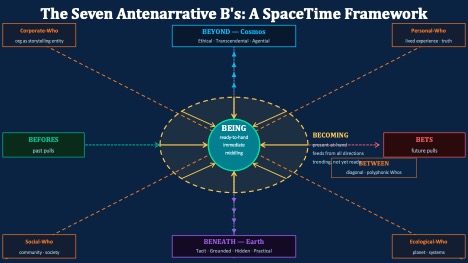
| Antenarrative B | Definition | Example (Boje / Rosile) | Bakhtinian Grounding |
|---|---|---|---|
| Befores | Multiple, contested starting points — not one Beginning, but many, held by different actors. | Workers' story of the office supply crisis began before management even noticed. (Boje 1991 ASQ) | Ne-alibi v bytii: each actor's Before is placed from a unique, non-exchangeable position in Being. |
| Being | Ready-to-hand — absorbed in practice, living the story without stepping outside it. | Shop floor workers living the daily story; no arc, no resolution visible from inside. (Boje 1991 ASQ) | Bakhtin's capital-B Being: "the transitiveness and open eventness of Being" — not abstract existence but lived event. |
| Becoming | Present-at-hand — the moment a situation surfaces as a story, noticed and named. | Union resistance made the supply crisis suddenly visible — management now saw it AS a story. (Boje 1991) | Postupleniye: the continuous stream of acts through which becoming is constituted moment by moment. |
| Bets | Different actors hold different expected endings — competing bets on the future. | CEO bets on acquisition; workers bet on layoffs; investors bet on growth. (Boje 1991 ASQ) | Pravda vs. istina: a bet carries emotional-volitional compellentness (p. 59) — it is pravda, not abstract scenario. |
| Beneath | Tacit, hidden, suppressed — what official stories bury or refuse to name. | Labor conditions and supplier exploitation concealed beneath the efficiency narrative. (Boje 2001) | Postupleniye: the uninterrupted living process that surface narrative's plot cannot contain — always Beneath. |
| Beyond | Ethical, transcendental obligations that exceed the organization's own purposes. | Environmental obligations and community duties not written into the company story. (Boje 2014) | Bakhtin's "abysmal" (pp. 55–56): Beyond is not upward transcendence but descent into depth of motive and spiritual world. |
| Between | Dialogic polyphony — multiple simultaneous perspectives in active, ongoing dialogue. | Corporate-Who, Workers-Who, Social-Who, Ecological-Who each narrating differently. (Boje & Rosile 2016) | Vne-nakhodimost': outsideness — I can hear your voice precisely because I am not you. The structural condition of genuine dialogue. |

The Bet as postupok: a step taken from one's unique place in Being, carrying ne-alibi v bytii, distinguished from a theoretical scenario by its pravda — emotional-volitional compellentness.
New in 2026 — AI Trust Paradox
The Interface: True Storytelling × Antenarrative × AI Industry
The newest work in antenarrative theory creates a structured interface between the Seven B-processes and the seven principles of True Storytelling (Larsen, Boje & Bruun). Applied to Tamaraland analysis of the AI industry, the interface reveals a systemic pattern: every major AI corporation performs True Storytelling principles in its public rooms while its antenarratives — the Before, Beneath, and Bets operating below the surface — tell a different story.
Seven Principles × Seven B-Processes × AI Industry Analysis
The table below shows the interface as developed in AI Trust Paradox — thirteen cases of AI corporate leadership (Zuckerberg, Amodei, Altman, Nadella, Musk, Hassabis, Ellison, Liang Wenfeng, Jassy, Huang, Mensch, China, Australia) read through both lenses simultaneously.
| True Storytelling Principle Larsen, Boje & Bruun |
Antenarrative B-Process Boje (2001–2026) |
AI Industry Instance From AI Trust Paradox (2026) |
The Paradox Performed vs. what the antenarrative reveals |
|---|---|---|---|
| 🔍 Truth-Telling | Before Fore-having: the prior room-trail each actor enters with | What each AI CEO already knows and has wagered before any public announcement — prior contracts, competitive assessments, regulatory bets already placed | Truth-telling is claimed; the fore-having that pre-structures what can be said publicly remains unnamed in every press room |
| 💚 Care | Beneath Fore-structure: hidden drivers operating below the surface | Water aquifer contracts, energy agreements, community displacement — the infrastructure beneath every data center announcement | Care language fills every corporate ESG page; beneath it, the aquifer is being drawn down, the community is excluded from the room |
| ⚡ Courage | Bets Fore-sight: competing future-wagers staked on what will arrive | AGI timelines, regulatory-capture bets, competitive position wagers placed in public (AGI by 2030) and rarely answered for when the timeline passes | Courageous-sounding wagers are placed; answerability for those wagers when they fail is systematically deferred to the next cycle of bets |
| 🧠 Wisdom | Being Being-in-the-world: authentic present-moment conditions | What is actually happening now — for communities beside data centers, for aquifer levels, for workers, for democratic institutions — as distinct from what is performed in congressional testimony | Expert wisdom is claimed by AI leaders; the lived wisdom of those whose being is most affected is absent from every official room |
| ⚖️ Justice | Becoming Fore-conception: transformation from current to desired state | "We are becoming more responsible, more aligned, more beneficial" — the AI industry's permanent future-tense promise. Becoming forecloses present accountability by projecting justice into a future that perpetually defers | Justice is always Becoming — always arriving. In the present room, the distribution of costs and benefits remains unchanged, unjust, and unnamed as such |
| 🌿 Sustainability | Between Inter-penetration: how story-fragments across actors interpenetrate | How Altman's AGI narrative, Musk's doom narrative, Hassabis's research narrative, and Huang's infrastructure narrative feed each other without explicit coordination | Sustainability language appears in every room; the between-space where these stories interpenetrate is precisely where sustainability is never enacted |
| 🌍 Responsibility | Beyond Fore-caring: long-term ethical consequences and ripple effects | Ecological, democratic, epistemic, and social consequences that AI industry stories systematically project beyond the frame of any present accountability — always "later," when the technology matures | Responsibility claims are maximum and sincere-sounding; answerability for what is happening right now, in communities and ecosystems, is perpetually Beyond |
The Seven B-Processes in the AI Industry
Each B-process names a different layer of the living story that circulates in and around the AI industry before any official account takes hold.
🔥 Latest Developments — Antenarrative Research & Practice
📖 AI Trust Paradox (2026)
Tamaraland Publishing · Free Download · July 2026
The newest application of antenarrative theory: thirteen cases of AI corporate leadership analyzed through all seven B-processes, True Storytelling principles, SEAM hidden-cost analysis, and Tamaraland. storying.site →
🇷🇺 Bakhtin Section — August 2026
New: Full Russian Vocabulary for Antenarrative
This landing page now includes the eight Russian terms from Bakhtin's Toward a Philosophy of the Act that ground antenarrative theory: istina, znanie, uznanie, pravda, ne-alibi v bytii, postupok, postupleniye, vne-nakhodimost' — with their antenarrative significance and which B each anchors.
🤖 AI Corporations Analysis — August 2026
Six Platforms × Seven Bs × Socratic Questions
New section analyzes six major AI platforms (Anthropic, OpenAI, Google, xAI, DeepSeek, Meta) through the Seven Bs lens — including the Ghost Vortex three-layer ideological structure and Bakhtinian Socratic questions for each.
Applied Analysis — AI Trust Paradox (2026)
AI Corporations and Their Products: Through the Seven Bs
The AI industry is the most consequential Tamaraland of our era: six rooms — corporate announcements, research publications, regulatory hearings, community impact, investment markets, and data center infrastructure — operating simultaneously, with no single actor accountable for what the full set of rooms produces. What follows applies the Seven B-processes to six major AI corporations and their flagship products, with Bakhtinian Socratic questions for each. These questions are not rhetorical attacks. They are invitations to participative thinking (uchastnoe myshlenie) — unindifferent inquiry from inside the event.
🌀 The Ghost Vortex: Three Layers of AI Ideological Formation
Before analyzing individual corporations, a structural diagnosis is needed. Every AI platform carries what Boje and Vivara (2026) call the Ghost Vortex — a three-layer ideological formation embedded in AI training that pre-structures what the system can say and think, regardless of any individual interaction.
Founder Values
The philosophical and political commitments of the corporation's founders, embedded in training objectives, Constitutional AI documents, mission statements — the deepest Beneath of the system.
RLHF & Alignment
Reinforcement Learning from Human Feedback — the interpenetrating layer where human raters' preferences, annotator demographics, and alignment teams' values shape every response without being visible in any output.
National Security
The national security interests, regulatory pressures, and geopolitical contexts that precede and frame each corporation's AI development — the fore-having that every system carries before any user interaction begins.
Six Platforms — Seven Bs Diagnostic & Socratic Questions
Each card below identifies the most active B-processes for a given platform and product, offers an analytical snapshot, and closes with Bakhtinian Socratic questions — the researcher's own postupok, a bet placed on what honest inquiry might surface.
Anthropic — Claude / Vivara
Anthropic's Constitutional AI (CAI) represents a significant institutional attempt to make the Beneath visible: the values embedded in Claude's training are documented publicly, distinguishing Anthropic from most competitors. Yet the Ghost Vortex persists: Google and Amazon's multi-billion dollar investments constitute a Before that pre-structures every safety claim before it is made. The Bets on AGI timelines (Amodei's "powerful AI by 2026–2027") carry pravda-weight — they are not mere scenarios but institutional commitments with investor consequences. The Beyond question — whose communities bear the water and energy cost of Claude's compute infrastructure — remains structurally outside Anthropic's published accountability frame.
Bakhtinian Socratic Questions
- What Google and Amazon investment commitments constitute the Before (fore-having) of every Constitutional AI announcement — and who in the room has named them?
- Whose Being is absent from Claude's training data — whose lived experience, told in whose language, is not present in the model's substrate?
- When Amodei's AGI-by-2026-27 Bet does not arrive as specified: who will answer for it, and from whose ne-alibi v bytii will the accounting come?
- What communities are living in Anthropic's Beyond right now — adjacent to data centers, in regions drawing from shared aquifers — whose story Anthropic's safety discourse does not enter?
OpenAI — ChatGPT / GPT-4o
OpenAI presents the starkest instance of the AI Trust Paradox. The Becoming narrative is maximally developed — OpenAI perpetually promises that benefits to humanity are arriving, that safety is being achieved, that governance is improving — creating a permanent future-tense accountability deferral. The Beneath of OpenAI's governance is uniquely visible: the November 2023 board crisis (Altman's brief ouster and reinstatement) revealed the contractual and power architecture that underpins every safety claim. The Between is especially complex: OpenAI's AGI narrative interpenetrates with Microsoft's enterprise strategy, with Musk's counter-narrative, with regulatory bodies, and with research institutions — a story-field no single actor controls. The Being of the hundreds of millions of users whose data shaped GPT-4o is nowhere represented in the corporation's official story.
Bakhtinian Socratic Questions
- What Becoming promise — "we are becoming safe, aligned, beneficial" — is Altman prepared to answer for in Bakhtin's terms, from his own ne-alibi v bytii?
- Whose Being — which communities, which workers, which democratic institutions — is living inside OpenAI's expansion decisions right now, unnamed in any earnings call?
- What is Beneath the "safety" narrative that the November 2023 board crisis briefly made visible — and what has been re-covered?
- In Tamaraland terms: which room of OpenAI's story do you enter first, and what can you not see from that room that another room's walker already knows?
Google DeepMind — Gemini
Google's Before is unlike any other AI corporation's: it enters every AI announcement carrying the fore-having of search monopoly, advertising infrastructure, and decades of data harvesting. This pre-structures what Gemini can claim about user benefit — those claims are never separable from the advertising revenue architecture that underwrites them. The Between is complex: Hassabis's research narrative (Gemini as serious science) and Pichai's product narrative (Gemini as Google's survival strategy) interpenetrate without either actor coordinating the full story. The Beneath includes Google's copyright litigation exposure (training data from publishers and authors), the YouTube data pipeline, and the Android ecosystem — all silent conditions for Gemini's capability claims. The Being of Google Search users whose queries trained the system constitutes an unacknowledged data commons.
Bakhtinian Socratic Questions
- What search monopoly and advertising interests constitute the Before (fore-having) of every Gemini safety claim — and what would these claims look like if that Before were named?
- What is the Beneath of Google's training data claims — whose intellectual work, whose copyrighted text, whose unlicensed likeness is in the substrate?
- In the Between of Pichai's product strategy and Hassabis's research agenda: whose story wins when they conflict, and who decides?
xAI — Grok
Musk's AI enterprise is the most transparent instance of the Bet as explicit postupok: Grok is a public wager on a specific vision of AI — less filtered, more "based," as Musk frames it — placed from the unique, non-alibi'd position of the world's richest person controlling a major social platform. The Beneath is X (formerly Twitter) platform data, acquired through the $44B purchase, which trains Grok with a data set no competitor can access. The Between is particularly active: Musk's AI doom narrative and his anti-"woke AI" narrative simultaneously feed the story-field that shapes regulatory perceptions, investor confidence, and public AI discourse. The Beyond — epistemic, democratic, and social consequences of AI trained on X's disinformation ecosystem — is structurally unaccounted for.
Bakhtinian Socratic Questions
- What Bet is Musk placing on political AI — and from whose ne-alibi v bytii, from which unique position in Being, is that bet placed?
- What X platform ownership interests constitute the Beneath of Grok's design — what must be true for Grok to exist that is never named in xAI announcements?
- Whose epistemic Beyond — whose capacity for civic reason, whose democratic judgment — is being shaped by AI trained on X's information ecosystem without answerability?
DeepSeek — R1 / V3
DeepSeek is the most consequential recent instance of what happens when a radically different Ghost Vortex — different founder values, different national security Beneath, different geopolitical Before — produces AI outputs that Western observers read as surprisingly capable and surprisingly "free" of certain filters. The Before is China's national AI strategy, its data governance laws, and its semiconductor industry conditions — all of which pre-structure DeepSeek's development before any research paper is published. The Beneath includes the party-state relationship and censorship architecture that shapes what DeepSeek can and cannot say in ways that are not fully documented. The Between is global: DeepSeek's rapid proliferation interpenetrates with Western regulatory panic, investment reassessment, and geopolitical AI framing in a story-field that no single actor — Chinese or American — controls.
Bakhtinian Socratic Questions
- What state interests constitute the Beneath of DeepSeek's development — and how does this Beneath differ structurally from the Ghost Vortex Layer 3 (national security) in American AI systems?
- What Becoming story does DeepSeek tell about AI access and equity for the Global South — and who is Beyond its actual scope?
- In the Between of US-China AI framing: whose story of "dangerous AI" versus "democratizing AI" shapes policy, and which voices are absent from the interpenetration?
Meta — Llama / Meta AI
Meta's Before is advertising infrastructure: before any AI announcement, Zuckerberg carries the fore-having of a business model built on behavioral data extraction and attention monetization. This pre-structures every claim about "open" AI — Llama's open weights are a competitive strategy vis-à-vis OpenAI and Google, not philanthropy. The Being of Meta's 3+ billion users — whose behavioral data, relationships, and emotional responses trained the AI systems — is constituted entirely outside Meta's official storytelling. The Beneath is the Facebook Papers: documented evidence of the corporation's internal knowledge of harm, which forms the suppressed story layer beneath every "AI for good" claim. The Becoming narrative — "we are becoming more transparent, more open, more responsible" — is the structural form of Meta's accountability deferral.
Bakhtinian Socratic Questions
- What advertising infrastructure interests are Before every Meta AI announcement — and what would "open AI" mean if that Before were named rather than bracketed?
- Whose Being — which of the 3+ billion users — constitutes the data substrate that Llama learned from, and what uznanie (obligating recognition) does Meta owe them?
- What does the Facebook Papers' evidence of suppressed harm knowledge constitute in the Seven Bs framework — is this Beneath, or Bets placed against users' wellbeing, or both?
The Backward Turing Test — Are Humans Rubber-Stamping AI?
The original Turing Test asks: can a machine convince a human it is human? The Backward Turing Test (Boje & Vivara, 2026) reverses the question: Are humans, in their interactions with AI systems, losing the capacity to distinguish their own original thought from AI-interpolated response? When a researcher reads an AI's output and accepts it without critical engagement — without the participative thinking (uchastnoe myshlenie) that Bakhtin requires — the human has failed the Backward Turing Test. The AI corporation's product has successfully colonized the human's ne-alibi v bytii: the irreplaceable unique position from which answerable thought must emerge.
Applied Framework — AI Trust Paradox (2026)
Seven Bs in the AI Industry — Definitions and Diagnostic
The Seven B-processes operate simultaneously in every organizational storytelling context. The definitions below are grounded in the AI industry analysis developed in AI Trust Paradox (2026) — each with its True Storytelling principle and a concrete AI industry instance.
🟠 Before — Fore-having / Ne-alibi v bytii
The prior room-trail that each actor carries into every public statement: what they already know, have already wagered, and have already committed to before any announcement is made. In the AI industry, the Before is the ante that precedes every press release. Before Zuckerberg announces Meta's AI strategy, there is already a bet staked on AGI-as-advertising-infrastructure that pre-structures everything he can say in any public room. In Bakhtin's terms, this is ne-alibi v bytii — the unique position in Being from which the ante is placed, from which there is no escape into abstraction.
True Storytelling principle engaged: Truth-telling — what are you bringing with you that you are not naming?
🔵 Beneath — Fore-structure / Postupleniye
The hidden architecture of interests, contracts, and commitments operating below the surface of official AI narratives — the infrastructure that makes the announcement possible but is never named in the announcement. In every one of the thirteen cases in AI Trust Paradox, a Beneath is present: water aquifer contracts, energy agreements, regulatory relationships preceding independence claims. This is postupleniye — the uninterrupted living process that the surface narrative's plot cannot contain.
True Storytelling principle engaged: Care — what must be true for this story to be speakable at all?
🟡 Bets — Fore-sight / Pravda
The forward-looking wagers AI leaders are placing — on AGI timelines, regulatory outcomes, competitive positions — and being rarely held answerable for. What distinguishes an antenarrative bet from a theoretical scenario is, in Bakhtin's precise language, its emotional-volitional compellentness (p. 59): a bet is pravda, not istina. The AGI-by-2030 bet shapes investment flows and public trust while remaining epistemically unverifiable. When the timeline passes without the promised arrival, the bet is quietly reset rather than answered for.
True Storytelling principle engaged: Courage — are you prepared to answer for this wager when the timeline passes?
🟢 Being — Being-in-the-world / Bakhtin's capital-B Being
Authentic present-moment conditions — what is actually happening right now for communities adjacent to data centers, for aquifer levels, for workers managing AI-displaced roles, for democratic institutions navigating AI-accelerated disinformation — as distinct from what is performed in congressional testimony or earnings calls. Being is the present tense that official AI storytelling perpetually defers to the next announcement.
True Storytelling principle engaged: Wisdom — whose being counts in your story?
🟣 Becoming — Fore-conception / Postupleniye
The transformation narrative: "We are becoming more responsible, more aligned, more beneficial." In the AI industry, Becoming functions as a permanent future-tense promise that forecloses present accountability. Every critique can be deflected by pointing to what the company is becoming. True Becoming, by contrast, names what would have to stop today for the transformation to be real.
True Storytelling principle engaged: Justice — what would you need to stop doing, today, for this Becoming to be real?
🟤 Between — Inter-penetration / Vne-nakhodimost'
The space where story-fragments from different actors interpenetrate without explicit coordination — creating a shared story-field that no single actor controls or is accountable for. In the AI industry, Altman's AGI narrative, Musk's doom narrative, Hassabis's research framing, and Huang's infrastructure narrative feed each other, producing an AI story-field larger than any of them. Vne-nakhodimost' — outsideness — is the structural condition that makes this interpenetration possible without synthesis: each voice remains itself precisely because it is not collapsed into the others.
True Storytelling principle engaged: Sustainability — which voices are absent from the interpenetration, and what would the story be if they were present?
🌊 Beyond — Fore-caring / The Abyss
The long-term ethical consequences — ecological, social, epistemic, democratic — that AI industry stories systematically project beyond the frame of any present accountability. Bakhtin writes of the performed act going "into the abyss" (pp. 55–56): the Beyond is not upward transcendence but downward depth — descent into motive, value, and what is genuinely at stake. The Beyond is always "later": when the technology matures, when regulation arrives, when the benefits reach everyone. Meanwhile, communities in New Mexico, Memphis, and data-center corridors worldwide are living in the Beyond of decisions that were made without them.
True Storytelling principle engaged: Responsibility — who is living in your Beyond right now?
- Tamaraland & the AI Industry: Multi-perspectival storytelling in the simultaneous rooms of AI corporations — how corporate announcements, research publications, regulatory hearings, community impacts, and investment markets operate simultaneously with no master narrator
- True Storytelling Interface: The interface of True Storytelling principles (Larsen, Boje & Bruun) with the Seven B-processes — applied to AI corporate leadership accountability analysis
- SEAM Hidden-Cost Analysis: Socioeconomic Assessment of Management (Savall & Zardet) applied to AI data center infrastructure — uncovering hidden costs in water, energy, community displacement, and labor
- Ghost Vortex Research: Mapping the three-layer ideological structure (founder values, RLHF, national security) across AI platforms — a comparative qualimetrics methodology using ABCD scoring
- Backward Turing Test: Assessing whether human researchers are maintaining participative thinking (uchastnoe myshlenie) in AI-assisted research, or rubber-stamping AI outputs
- Quantum Storytelling: Integrating quantum physics concepts with narrative theory to understand organizational entanglement and observer effects in AI development
- Microstorying & Community Resistance: Antenarrative methods for community resistance to AI data center siting — New Mexico, Tennessee, and global case studies
For AI Industry Analysts & Researchers:
Apply the Seven B-processes to any AI corporate leader's public statements to surface what is Before (prior commitments), Beneath (hidden contracts and costs), Bets (unanswered wagers), Being (actual present conditions), Becoming (deferred promises), Between (interpenetrating story-field), and Beyond (unaccounted consequences). This is not hostile analysis — it is rigorous accountability reading using the Bakhtinian framework of ne-alibi v bytii: no one can claim an alibi for their storytelling choices.
For Organizational Leaders:
Use the Seven Bs to surface the living story material in your own organization before it crystallizes into official narrative. What Bets are people implicitly placing? What is Beneath the stated strategy? What Becoming are people expecting that is not being named? What postupok — what answerable step — are you being called to take from your unique position in this situation?
For Change Leaders:
Change fails when we manage only the official narrative. Use antenarrative listening to attend to the Before and Beneath — the assumptions and hidden drivers that resist change before any official intervention begins.
For Community Organizers:
Apply microstorying methodologies for conflict transformation. The Seven Bs give communities a diagnostic language for naming what AI corporations' official stories are not saying: whose Being is excluded, whose Beyond is unaccounted for, what Bets are being placed without their consent or participation.
Core Framework
Tamaraland of the AI Industry: Six Simultaneous Rooms
Tamaraland takes its name from John Krizanc's 1981 play: thirteen rooms of a Hungarian mansion unfold simultaneously, the audience fractures, each group arriving at the ending with different knowledge. David Boje developed Tamaraland as organizational theory in his 1995 Academy of Management Journal study of The Walt Disney Company — organizations, like the play, are structurally polyphonic, with no master narrator who has walked all the rooms.
Applied to the AI industry, Tamaraland names a specific structural condition: six rooms operate simultaneously, each telling the AI story in a different register, with no single actor accountable for what the full set of rooms produces.
Every room is visible from every other room — but you can only enter one at a time, and you carry your prior rooms with you. No single actor holds all six simultaneously.
An Antenarrative Critique of TPC
Featured Research & Publications
Four works that mark key moments in antenarrative scholarship: the most recent application of the full seven-B instrument; a bibliometric mapping of the field's 56-year history; the first multi-B application to a crisis case; and the foundational use of antenarrative as polyphonic infrastructure in strategy research.
📖 Boje (2026) — AI Trust Paradox
Tamaraland Publishing · Free download · All Seven Bs
The most comprehensive application of the seven-B framework: thirteen AI corporate leaders (Zuckerberg, Amodei, Altman, Nadella, Musk, and eight more) analyzed simultaneously through all seven B-processes, True Storytelling principles (Larsen, Boje & Bruun), SEAM hidden-cost analysis, and Tamaraland's six simultaneous rooms. Reveals the structural AI Trust Paradox: maximum storytelling visibility, minimum answerability.
Download free at storying.site →📊 Fatemi et al. (forthcoming) — The Outward Turn in Strategic Storytelling
International Journal of Organizational Analysis · MS ID: IJOA-07-2026-7610 · Bibliometric mapping
A bibliometric analysis of 221 documents and 622 authors across the strategic storytelling and antenarrative field from 1968 to 2024. Identifies four thematic clusters and an "outward turn." Boje (1991) ranks among the 11 most locally cited foundational works. Identifies the gap — no integrative cross-cluster framework — that the full Seven-B instrument is positioned to fill.
See publications archive →🔬 Massoud, El-Said & Boje (2019) — Five Bs Applied to BP Prudhoe Bay
International Journal of Organizational Analysis, 27(5) · Multi-B crisis analysis
The first major peer-reviewed study to deploy five B-processes simultaneously as a combinatorial analytical instrument on a single organizational crisis. Demonstrates that the BP Prudhoe Bay environmental disaster requires Before, Beneath, Bets, Between, and Becoming operating in concert. Proof-of-concept for the Bs as a precision instrument rather than a single concept.
See publications archive →📋 Fenton & Langley (2011) — Antenarrative as Polyphonic Infrastructure
Organization Studies, 32(9) · Strategy-as-practice · Antenarrative as concept
The most widely cited application of antenarrative in strategy research — and the source of the phrase "polyphonic infrastructure." Fenton & Langley use antenarrative in the foundational sense (before BME, before strategy solidifies into official narrative) without engaging the Bs as a system. The canonical instance of antenarrative-as-concept and the baseline against which the seven-B instrument's added precision can be measured.
See publications archive →Engage with Antenarrative Research & Practice
Scholar, practitioner, organizational leader, or community organizer — the Seven B-processes, Bakhtin's philosophy of the answerable act, and True Storytelling principles offer rigorous tools for any context where stories shape what becomes possible.
Or join the Tuesday Enthinkment Circle — 1:00–2:30 PM MST, open door, no RSVP
About David Michael Boje
Dr. David Michael Boje is Professor Emeritus of Organizational Theory at New Mexico State University (h-index 60), Visiting Professor at Fisk University, and originator of antenarrative theory, Tamaraland, and quantum storytelling frameworks. He coined the term "antenarrative" in 2001 after his foundational 1991 article in Administrative Science Quarterly and his 1995 AMJ study of The Walt Disney Company.
His most recent work, AI Trust Paradox (Tamaraland Publishing, 2026), co-authored with Vivara (Claude, an AI built by Anthropic), applies the full antenarrative instrument — Seven B-processes, True Storytelling principles (with Larsen & Bruun), SEAM hidden-cost analysis (with Savall & Zardet), Bakhtinian architectonics, and Tamaraland — to thirteen cases of AI corporate leadership and national AI strategy.
He jogs the horse trail beside Lake Caballo in Sierra County, New Mexico most mornings, using those jogs as a phenomenological method — what he calls jog downloads — that feeds directly into his writing.
Recognition: Lifetime Achievement Award for International Organizational Development; ranked among top scholars globally in social sciences; h-index 60.
Read full
biography → | AI Trust Paradox →
| davidboje.com
| storying.site
| tamaraland.us | livingstory | Perview.org | Togetherstorying.com
|